STATEMENT
My work is a deep dive into the human psyche, exploring themes such as mental illness, grief, fear, anger, violence, horror, mythology, sexual pleasure, beauty, and aging. I am captivated by the complexity, nuance, and mystery of human emotion and psychology. I paint portraits of female figurines whose faces and expressions reveal a spectrum of psychoanalytic extremes ranging from fiery passion to silent panic. The scale of the painting corresponds with the figure's emotional state. I create disquiet depictions of surreal domestic spaces in which shiny, melting, translucent, ghostly, and fractured figurines appear to be on the edge of a mental breakdown; their emotional and mental states are manifested through various stages of physical collapse. Painting is an act of introspection and self-revelation, a celebration of the human hand's attempt to interpret and emulate reality.
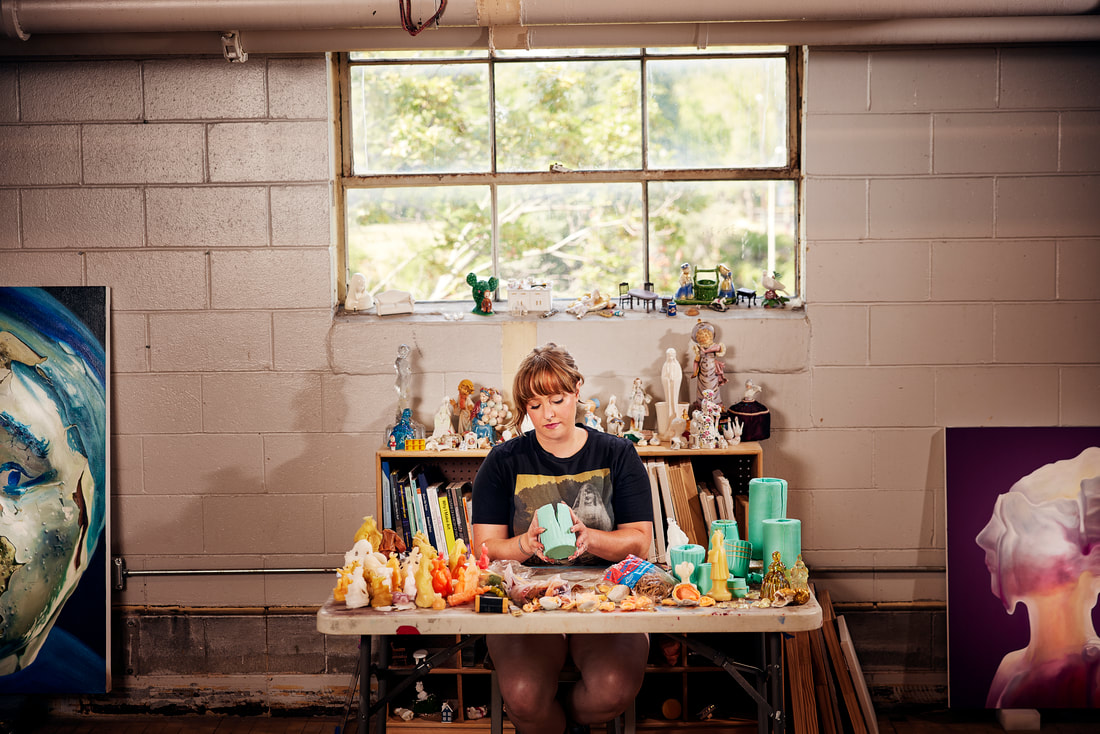
My creative process begins with a treasure hunt for figurines that appear haunted, sad, pensive, sexual, or otherwise easy to anthropomorphize. To elucidate for the viewer what I see in the objects, I arrange them in theatrically lit scenes inside dollhouses, transforming them through paint, wax, and resin before photographing them and using them as the basis for my paintings. I use bright colors and dark humor to engage viewers, making my work a catalyst for uncensored conversations about vulnerability, empathy, and connection.
I started collecting figurines and miniatures because of my grandmother. For 11 years, my mother and I cared for her as she battled dementia. As her mental state deteriorated, she began arranging her collection of figurines and fake flowers in still-life setups in her kitchen until almost every surface was covered in them. Walking into her home felt like entering a portal into her mind during a time when her home, routines, and objects were the only things tethering her to reality. This experience led me to study the connection between the mind, body, home, and the evocative object.
Objects hold our memories and can be catalysts for thought. The domestic space is a good metaphor for the psyche because our homes are extensions of ourselves like no other architecture. They are places of comfort and control where we can be ourselves, but we all know domesticity has a dark side. I represent the domestic space using dollhouses and miniatures, which allow viewers to project movement or narrative but are frozen in time, making the overall atmosphere one of stillness and silent anticipation. I was initially drawn to using dollhouses and figurines because they give me control over the lighting, color, and composition. Still, I continue to use them because they are loaded with gender associations. Using female and androgynous figures is a deliberate choice, connecting me to my matriarchal lineage as I reconcile growing up in a conservative home in Alabama with my feminism and decide which things from my upbringing I want to hold onto and what I need to let go of.
My work is a deep dive into the human psyche, exploring themes such as mental illness, grief, fear, anger, violence, horror, mythology, sexual pleasure, beauty, and aging. I am captivated by the complexity, nuance, and mystery of human emotion and psychology. I paint portraits of female figurines whose faces and expressions reveal a spectrum of psychoanalytic extremes ranging from fiery passion to silent panic. The scale of the painting corresponds with the figure's emotional state. I create disquiet depictions of surreal domestic spaces in which shiny, melting, translucent, ghostly, and fractured figurines appear to be on the edge of a mental breakdown; their emotional and mental states are manifested through various stages of physical collapse. Painting is an act of introspection and self-revelation, a celebration of the human hand's attempt to interpret and emulate reality.
My creative process begins with a treasure hunt for figurines that appear haunted, sad, pensive, sexual, or otherwise easy to anthropomorphize. To elucidate for the viewer what I see in the objects, I arrange them in theatrically lit scenes inside dollhouses, transforming them through paint, wax, and resin before photographing them and using them as the basis for my paintings. I use bright colors and dark humor to engage viewers, making my work a catalyst for uncensored conversations about vulnerability, empathy, and connection.
I started collecting figurines and miniatures because of my grandmother. For 11 years, my mother and I cared for her as she battled dementia. As her mental state deteriorated, she began arranging her collection of figurines and fake flowers in still-life setups in her kitchen until almost every surface was covered in them. Walking into her home felt like entering a portal into her mind during a time when her home, routines, and objects were the only things tethering her to reality. This experience led me to study the connection between the mind, body, home, and the evocative object.
Objects hold our memories and can be catalysts for thought. The domestic space is a good metaphor for the psyche because our homes are extensions of ourselves like no other architecture. They are places of comfort and control where we can be ourselves, but we all know domesticity has a dark side. I represent the domestic space using dollhouses and miniatures, which allow viewers to project movement or narrative but are frozen in time, making the overall atmosphere one of stillness and silent anticipation. I was initially drawn to using dollhouses and figurines because they give me control over the lighting, color, and composition. Still, I continue to use them because they are loaded with gender associations. Using female and androgynous figures is a deliberate choice, connecting me to my matriarchal lineage as I reconcile growing up in a conservative home in Alabama with my feminism and decide which things from my upbringing I want to hold onto and what I need to let go of.